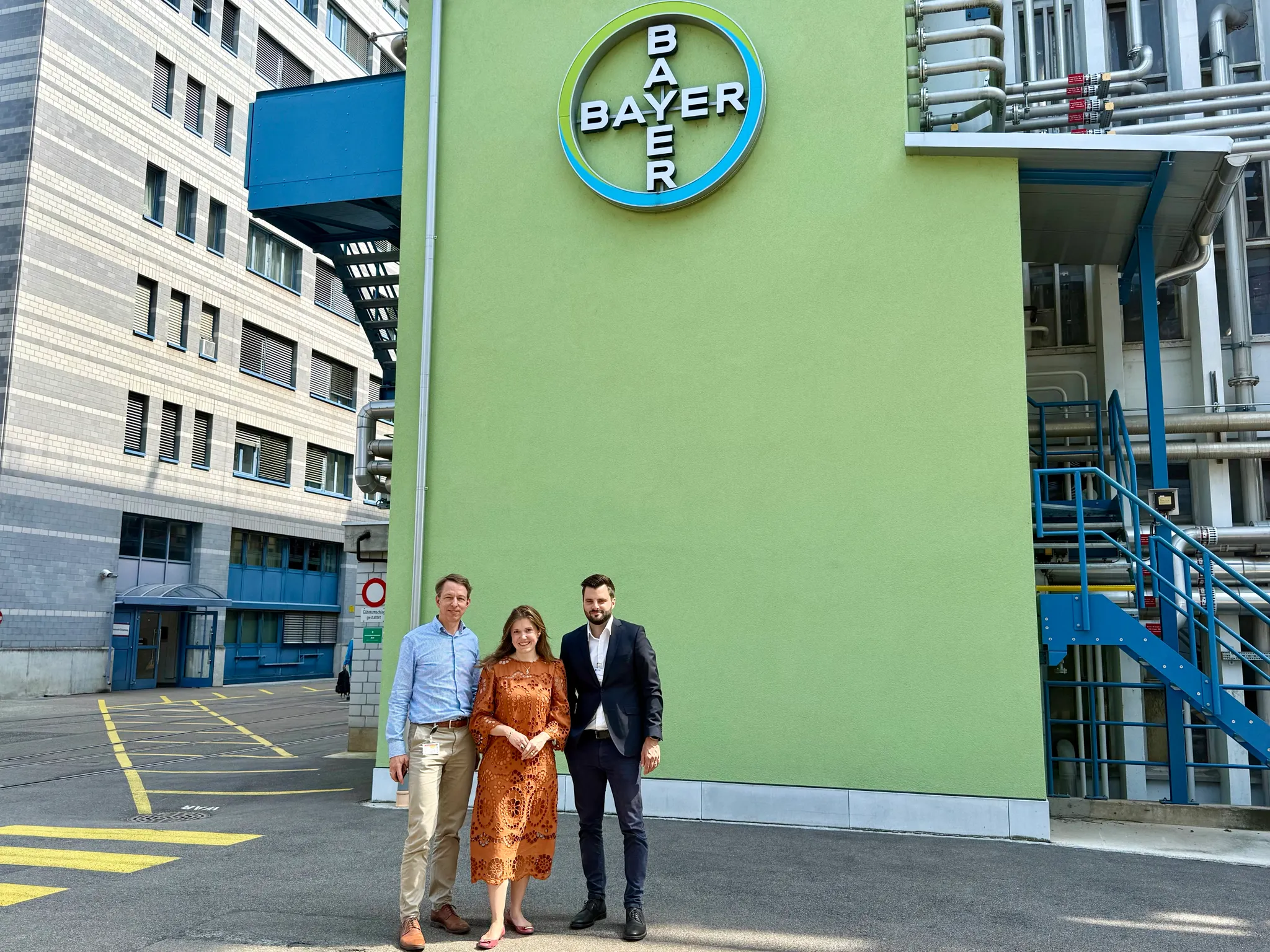
Muttenz, just east of Basel, is home to Bayer Switzerland’s only production site. Here, in the heart of the Getec Park industrial center, the company manufactures active ingredients for crop protection — globally networked, locally embedded. “We are globally competitive in a high-wage country like Switzerland. The only way to do that is through talent and technology,” says Dr. Felix Hanisch, who leads the site with around 280 employees.
A trained chemical engineer, Hanisch has been with Bayer for decades in a range of different roles. Today, as Site Lead, he still sees himself first and foremost as an engineer. “At heart, I’ve remained an engineer. If I need to understand something, I visit the plant and that’s where I feel happiest.”
An Applied PhD as a Launchpad
Hanisch’s path into industry began with a practical focus during his doctoral research at TU Dortmund. “We worked in tandem: I focused on the practical implementation, my colleague on the theory. Our research was about the optimal control of chromatography systems.”
His work took place within a real-world test plant, embedded in an industry partnership – a powerful foundation, both technically and personally. “That’s where I learned to organize myself, convince others, and work with teams. Those soft skills help me just as much today as the technical depth does.” These experiences have profoundly shaped his perspective on fostering young talent: those who have benefited themselves pass it on – that’s how Hanisch sees his role today.
Thesis Projects as a Learning Space
Hanisch’s connection to academia isn’t just a talking point, it’s part of his leadership approach. “I personally benefited from working in an applied setting during my studies. I want to offer students the same opportunity today.”
Bayer Switzerland works with several academic institutions – including ETH Zurich, IMD Lausanne, and, most closely, FHNW in Muttenz. “Last year, we had a Master’s thesis focused on continuous manufacturing. The experiments were done in our lab, the thesis defense took place at FHNW.”
For Hanisch, these collaborations are a strategic investment: “They bring external expertise into the company and help us explore questions where we don’t yet know the outcome – and are willing to leave room for experimentation.” Even supervisors benefit: “Students bring fresh thinking. They challenge our assumptions and push us out of our comfort zones.”
Thesis Collaborations as Site Strategy
Hanisch doesn’t see regional cooperation as a goodwill gesture. For him, it’s part of a deliberate site strategy.
“Human capital is what makes a location like Switzerland attractive. That creates both responsibility —and enormous potential.”
The topics are changing fast: biocatalysis, circular economy, and sustainability are becoming central. “We’re about to introduce a enzyme-based katalytic reaction in production. Twenty years ago, that wouldn’t have even been on the radar.”
Expectations from students are also evolving: “People want more feedback and guidance. ‘Go ahead and we’ll talk in three months’ doesn’t work anymore – and that’s a good thing.”
Many companies still hesitate when it comes to working with students. Hanisch wants to change that:
“Today’s students are tomorrow’s workforce. If you’re not supporting thesis work now, you can’t complain later about the talent shortage.”
And from a business perspective, the investment pays off: “Supervising a thesis takes a manageable amount of time – and it can deliver incredible value. Worst case, you’ve spent a few hours. Best case, you gain real insight.”
His advice for companies: “Start small. A semester project, a short internship. You don’t have to hire someone right away. But you always learn something and you open doors for both sides.”
Looking Ahead: Lifelong Learning
For Hanisch, thesis collaborations go far beyond talent development, they are a gateway to lifelong learning. “Our employees benefit too. They reflect on their knowledge, engage with new topics and stay connected to academia.”
This dialogue is essential: “Research doesn’t always have to be immediately applicable. But we should create more points of contact – through joint projects, conversations, and shared goals.”
To degree program leaders, he offers a clear message: “Many are already doing a great job combining fundamentals and application. That mix is what keeps our innovation engine alive.”