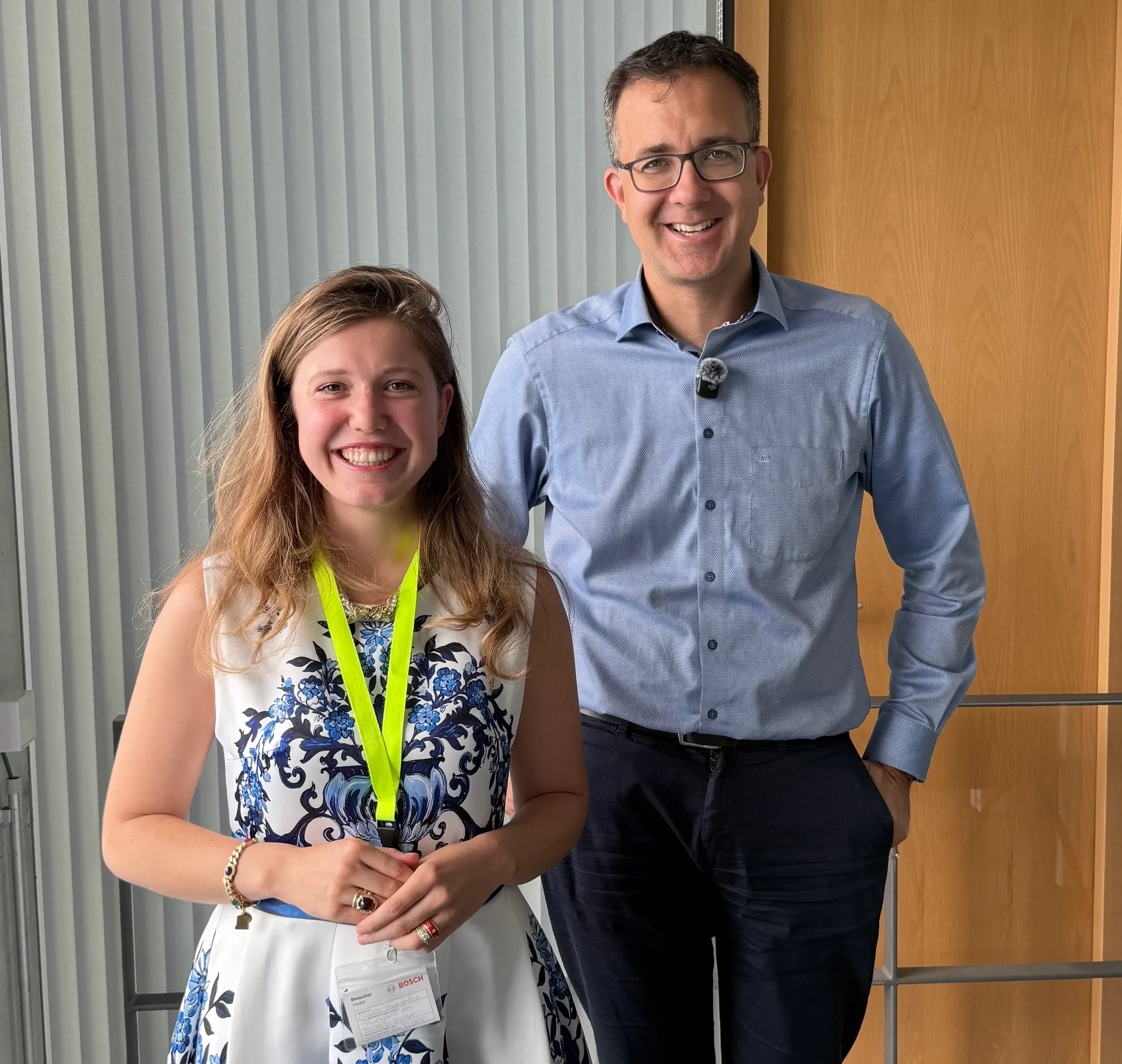
Matthias Dannenberg leads the Finance & Controlling division at Bosch Mobility Electronics, overseeing around 70 employees directly and about 300 finance professionals globally. His role ensures that financial data is not only accurately collected, but also strategically interpreted.
“We turn numbers into messages,” is how he sums up his responsibility. Whether it's control units, sensors, or semiconductors – Dannenberg’s team manages the financial steering of these business areas. But it’s not just about numbers: “We analyze which products are successful, where investments make sense, and how efficient our processes are.” His motivation is unmistakable: “I genuinely enjoy developing business strategy, especially in tandem with numbers.”
Future Skills in Finance & Controlling
“A basic understanding of balance sheets isn’t enough anymore,” says Dannenberg. Today’s finance professionals must look beyond the financial statements. “You need to understand sales, engineering, and production to extract real insights from data.”
A key capability today: understanding digital business models – like software-defined vehicles, data-driven control systems, and the role of artificial intelligence.
“Statistics and data literacy should play a much bigger role in business degrees. That’s the foundation for skills in Python, data analytics, or even AI tools.”
But technical expertise alone won’t cut it. Just as essential are communication skills, project competence, and leadership potential. “You need to bring people along – with numbers as your foundation.”
His advice? Gather interdisciplinary experience, especially through internships and thesis projects. “Don’t do consulting three times or industry three times – mix it up and learn something from every station.”
Thesis Projects as a Tool for Skill Development
How can this skill development be supported in a meaningful way? For Dannenberg, thesis projects are an ideal vehicle: “They connect students and companies at eye level. Theory meets reality.” At Bosch, he supports a range of formats: individual thesis projects, group work, or research partnerships with universities.
One example: a project investigating how the controlling function is evolving through digitalization – from classic number crunchers to business partners or data scientists. Another project analyzed admin and sales costs across 18 international production sites. “These are outcomes we can put to work immediately,” as Dannenberg explains. But he stresses the importance of a well-structured framework:
"You need a solid match. Good supervision takes time – both sides have to be aware of that.”
He’s especially focused on real-world relevance: “What’s the use of a perfectly theoretical thesis if it doesn’t lead to action?” That’s why he advises students to always include a concise executive summary with their thesis: “Three pages that clearly say what needs to be done.”
In the best-case scenario, strong thesis work can even open doors to a job: “We've had many cases where collaboration led directly to full-time employment.”
A Message to Degree Program Leaders
Matthias Dannenberg offers a clear message to academic program directors: “We still need strong young talent in Finance and Controlling – also in manufacturing industries.” He firmly believes universities play a vital role in equipping young professionals with solid expertise and curiosity for real industrial contexts.
“Not everything happens in start-ups or software-only environments.”
The manufacturing industry, too, offers exciting challenges, real responsibility, and significant innovation potential – “if it’s communicated clearly and made tangible through practice-oriented formats.”
His wish: that universities build more bridges to business practice – through project-based courses, case studies, excursions, and thesis collaborations. “If we manage to think of theory and practice as mutually reinforcing, everyone wins – students, universities, and companies.”