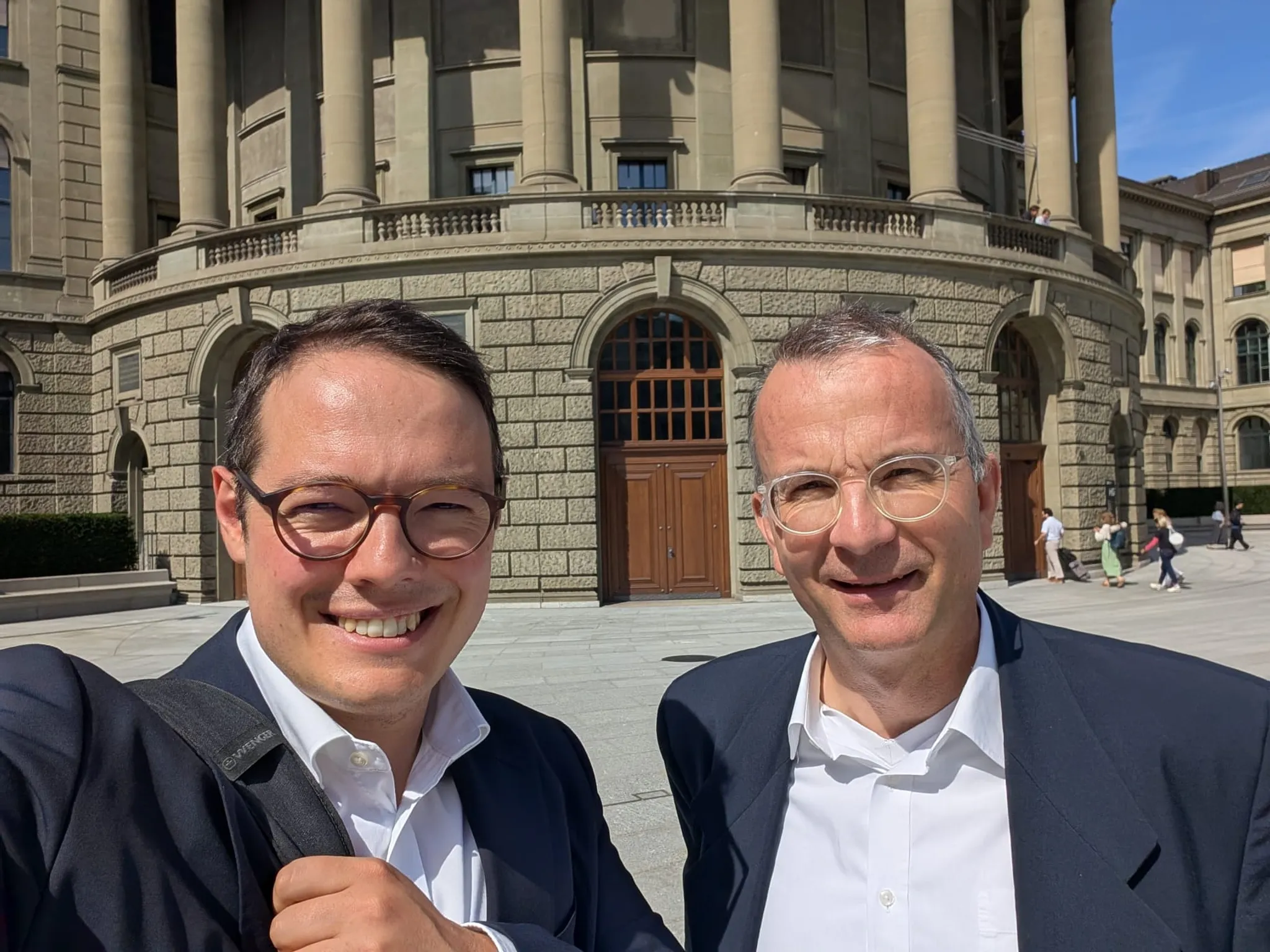
Transitioning from the corporate world to academia, and from multinational structures back to his alma mater, came at the perfect moment. After 12 years commuting between Zurich and Munich, returning to ETH Zurich was “the right step at the right time,” says Weibel.
At the same time, the move marked a professional homecoming. During his years in industry, he regularly gave guest lectures. “I’ve always enjoyed working with students,” he says. Now, he combines that passion with a strategic role in research transfer – a rare opportunity.
His perspective is clear: “I take a more economic, business-oriented approach to knowledge transfer – and that gives some questions a new spin.”
Where Science Meets Practice – Every Day
At ETH Zurich, where Weibel leads the ETH transfer unit, legal frameworks are part of everyday research. “Protection is the prerequisite for transfer,” he says. If research results are to make their way into the real world, the first step is clear ownership and the extent of ownership. This may sound technocratic, but it’s a critical success factor in university–industry partnerships.
With decades of experience at companies like Siemens and ABB, Weibel brings a pragmatic lens to university settings. His core message: less idealism, more realism. “My view of intellectual property is more commercially driven than what you might typically find at ETH.” And he’s building bridges between two worlds – academia and industry – that often underestimate each other.
Universities or Universities of Applied Sciences as Research Partner?
In Weibel’s view, universities are still underestimated in terms of their economic potential, especially by companies. Whereas fundamental research used to be done internally, it’s increasingly shifting to startups, spin-offs, and academic institutions. But this isn’t a step back, it’s an opportunity.
“Companies are outsourcing more and more foundational research and that’s a huge opportunity for institutions like ETH.”
Still, successful collaboration doesn’t happen by accident. Companies must ask themselves: Do I need fundamental research? Or a near-market solution? Weibel advocates for clear strategic positioning. That’s the key to building long-term partnerships – instead of relying on random, one-off projects. “Not every university fits every phase. For applied questions, a university of applied sciences might be the better fit. For deep tech, it’s ETH.”
No Transfer Without IP Protection
When it comes to intellectual property, a false choice is often made: protect it or share it. For Weibel, this is a misunderstanding: “It’s not a balance – it’s a sequence.” Before you can share technology, you need to protect it. Only then can ownership be clearly defined and partnerships fairly structured.
This insight is not just theoretical. During his time as Chief IP Counsel at Siemens, Weibel noticed how little university collaboration resulted in IP-ready outcomes – not due to lack of innovation, but because of unclear intent. “If a company simply commissions a set of measurements, that’s not research. That’s execution.”
His conclusion? Collaboration only works when the role of each partner is defined from the start – whether it’s:
- Foundational research with universities
- Product development with universities of applied sciences
- Or fast-paced iteration with startups
Spin-Offs: “Don’t Forget About IP”
What applies to big industry players is even more critical for spin-offs. Many young founders get overwhelmed by day-to-day operations — and neglect IP strategy. That’s a costly mistake. “Don’t forget about it,” Weibel warns. Investors pay close attention to tech protection. Without a solid IP foundation, securing funding becomes difficult. “They’re buying exclusivity and that requires legal certainty.”
For ETH transfer, this means acting early:
- Raising awareness among researchers
- Offering legal support to spin-offs
- And building the IP foundations that make real innovation possible
Looking Ahead: From Fear to Transparency
Beat Weibel brings clarity to the often fuzzy discussion of knowledge transfer. He’s not asking if collaboration between academia and industry is useful — but how it must be designed so that both sides benefit.
The answer?
- Clear strategic goals
- A solid legal framework
- And mutual openness to learning
“Universities provide the knowledge. Companies provide the application context. But to bring the two together, we need more than good intentions. We need structure.”